
Please Support Us
Your gift helps fund Biblephoria's free online courses and study materials.
Give Now- Home
- What Is Christmas?
- When Is Christmas?
When Is Christmas?
When people ask, “When is Christmas?” the straightforward answer is December 25. But the story behind that date is far more exciting than you would think.
Now let me take a moment to say that many of you are expecting a countdown timer to tell you when Christmas is. Well, look below this paragraph. We've got that too!
Countdown to Christmas
We also have an FAQ below if you don't have time to ready everything. It summarizes how December 25 was chosen. It can save you a lot of time scrolling through all the content (although we encourage you to read it all).
But I digress.
When Is Christmas?
To answer this question, let's ask another. Is Christmas specifically Jesus' birthday?
The short answer is we don't know.
The Bible never specifies the day of Jesus’ birth. In fact, for centuries, Christians didn't celebrate it at all. Over time, December 25 became the most widely recognized date, shaped by theological reflection, cultural adaptation, and historical precedent.
Early Hesitations About Celebrating Birthdays
In the earliest centuries of the church, the focus was not on Jesus’ birth but on His death and resurrection. Easter was the central feast, and the nativity was not marked with the same importance. Some Christian thinkers even resisted the idea of celebrating birthdays altogether.
One of the most notable voices was Origen of Alexandria in the 3rd century. He argued that birthday celebrations were a pagan custom. Because of this, Christian's shouldn't celebrate birthdays. This shows that the earliest believers were cautious about looking like the Roman or Greek world around them. For them, the significance of Christ’s mission was found in the cross and resurrection, not in the day He was born.
The First Attempts to Fix a Date
By the 3rd century, some Christian scholars began to speculate about when Jesus might have been born. Sextus Julius Africanus was an early historian. He proposed that Jesus was conceived on March 25, the spring equinox. Counting nine months forward placed His birth on December 25.
This calculation was not just mathematical. It was symbolic. March 25 was already associated with the creation of the world. Later, it would be coupled with the Annunciation — the angel Gabriel’s announcement to Mary. Placing the Incarnation on that date tied Jesus’ coming to themes of creation (Genesis 1:1) and renewal (Romans 12:2; 2 Corinthians 4:16; c.f. 2 Corinthians 5:17). December 25, then, became the natural conclusion of that theological reasoning.
Rome Adopts December 25
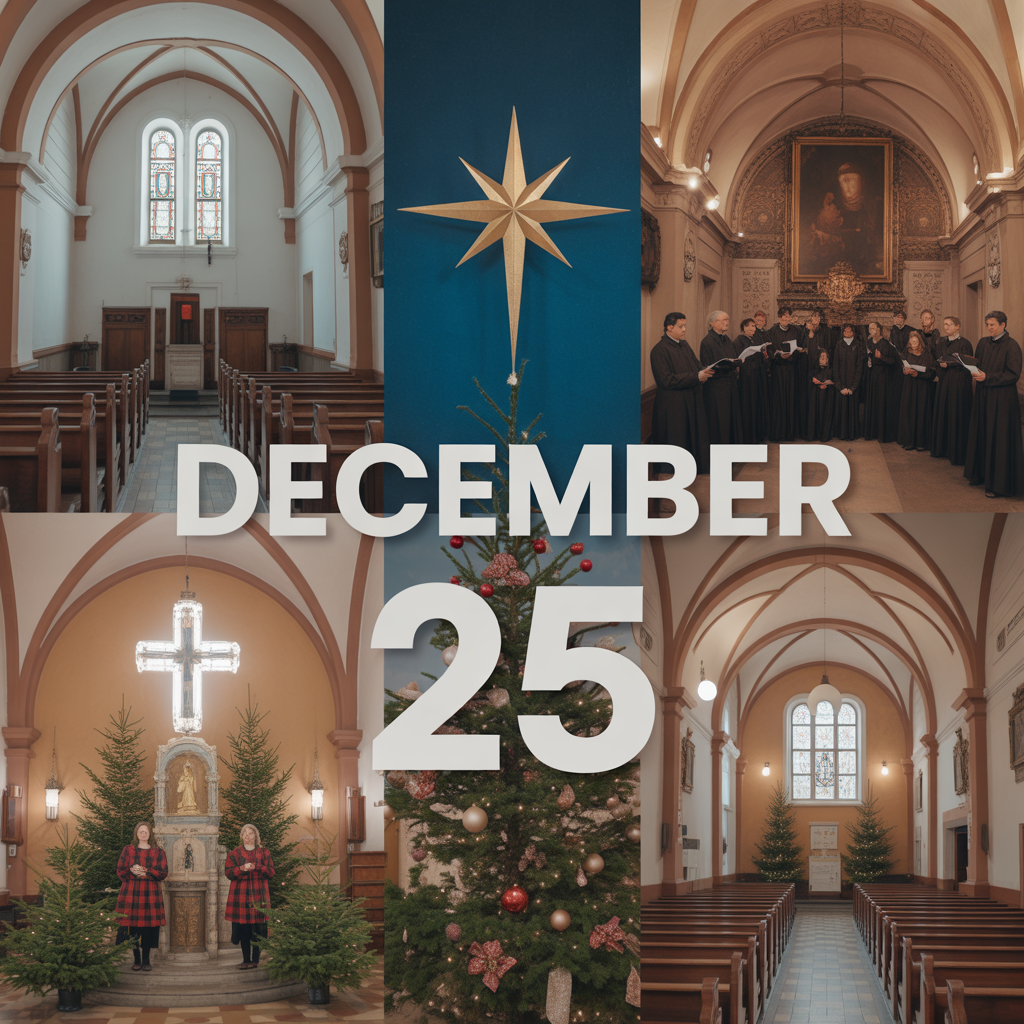
The first recorded celebration of Christmas on December 25 took place in Rome in 336 AD, during the reign of Emperor Constantine. Constantine had legalized Christianity, and the church was beginning to establish its calendar of feasts.
Why December 25? It had to do in large part with Julius Africanus’ calculation. But there was also a cultural consideration. The date coincided with the Roman festival of Sol Invictus (“Unconquered Sun”), which was celebrated at the winter solstice. By choosing this day, Christians claimed a day of paganism for themselves. The church presented Christ as the true light of the world, greater than the sun itself. This alignment allowed the church to redirect cultural attention from pagan festivals to the worship of Christ.
How the Date Spread and Evolved
Yet not all traditions followed the same calendar:
- Eastern Orthodox churches that still use the Julian calendar celebrate Christmas on January 7 (which corresponds to December 25 in the Julian reckoning).
- The Armenian Apostolic Church celebrates on January 6, combining Christmas with Epiphany.
- Local customs also shaped how the day was observed. In many European countries, gift‑giving happens on Christmas Eve. In North America, it is more common on Christmas morning.
These variations remind us that while December 25 is the dominant date, the Christian world has always expressed diversity in its observance. This, along with Africanus establishing a religious reason for the date long before, proves that Christmas is a distinct holiday from the winter solstice.
Why December 25 Matters
The choice of December 25 reflects the church’s effort to anchor Jesus’ birth in both theological meaning and cultural context. It shows how Christians engaged with surrounding traditions, transformed them, and gave them new focus.
- The date ties Jesus’ birth to cosmic rhythms — conception at the equinox, birth at the solstice, and gives them divine rather than naturalistic meaning.
- It proclaims Christ as the “true light,” surpassing pagan sun festivals.
- It demonstrates the church’s ability to adapt and sanctify cultural practices for Christian worship (Romans 14:5–6).
Today, while most Christians celebrate on December 25, others mark the day differently. What unites them is not the calendar but the conviction that God entered history in the person of Jesus Christ.
The Answer
So, when is Christmas? For most of the world, it is December 25. This date exists because of a blend of theological reflection, historical calculation, and cultural adaptation. From Origen’s skepticism to Julius Africanus’ calculation. From Constantine’s Rome to modern traditions. The story of Christmas’s date shows how faith and history intertwine.
So we don't have to ask, "When is Christmas?". It doesn't matter when we celebrate it. In fact, we should be celebrating Jesus in our hearts all year round.
Why?
Because He is truly the reason for the season and our life (Colossians 3:3–4). God bless.
Frequently Asked Questions
Why is Christmas celebrated on December 25?
December 25 was chosen in the 4th century, partly based on theological calculations linking Jesus’ conception to March 25 and partly to align with Roman solstice festivals. It became the standard date in Western Christianity.
Do all Christians celebrate Christmas on the same day?
No. Most celebrate on December 25, but some Orthodox churches using the Julian calendar mark it on January 7, and the Armenian Apostolic Church celebrates on January 6.
When did people start celebrating Christmas?
The first recorded celebration of Christmas on December 25 was in Rome in 336 AD, during the reign of Emperor Constantine.
What is the significance of December 25?
The date symbolizes Christ as the true light of the world, arriving near the darkest time of the year. It also reflects early Christian efforts to connect Jesus’ birth to cosmic and historical rhythms.

Want more Christmas? Go back to our main Christmas page.
Full disclosure: As an Amazon Affiliate, links to Amazon may earn Biblephoria.com a commission on qualifying purchases. This is just one of the things we do to support this cause. Thank you for your support.
Please Support Us
Your gift helps fund Biblephoria's free online courses and study materials.
Give NowRecent Articles


-
How Do I Obey God? Lesson 3
May 26, 26 08:41 PM
 How do I obey God? I mean, if I want to do it right, where do I start? Is there a right or wrong answer to this? Let's find out together.
 -
Can God Forgive My Sins?
May 19, 26 06:11 PM
Can God forgive my sins? Can He scrub away the guilt I feel and give me what I need? Forgiveness? Let's discover the answer to these questions together. -
Why Do I Feel Guilty?
May 07, 26 12:48 AM
Have you ever wondered "Why do I feel guilty?" Guilt is a constant in the human condition. But where does it come from? What takes it away? Let's find out.




Find our Privacy Policy and User Agreement here.