
Please Support Us
Your gift helps fund Biblephoria's free online courses and study materials.
Give Now- Home
- What Is Christmas?
- The Story of the Christmas Tree
Story of the Christmas Tree
Have you ever heard the story of the Christmas tree? Have you ever wondered where it came from? How it became a symbol of Christmas?
Let's talk about this evergreen (in more ways than one) symbol of Christmas. To help you digest this information, we've created a widget that summarizes everything for you.
Click here for our free e-book An Evergreen Tradition: The Story of the Christmas Tree right now!
The Story of the Christmas Tree
Ancient Roots
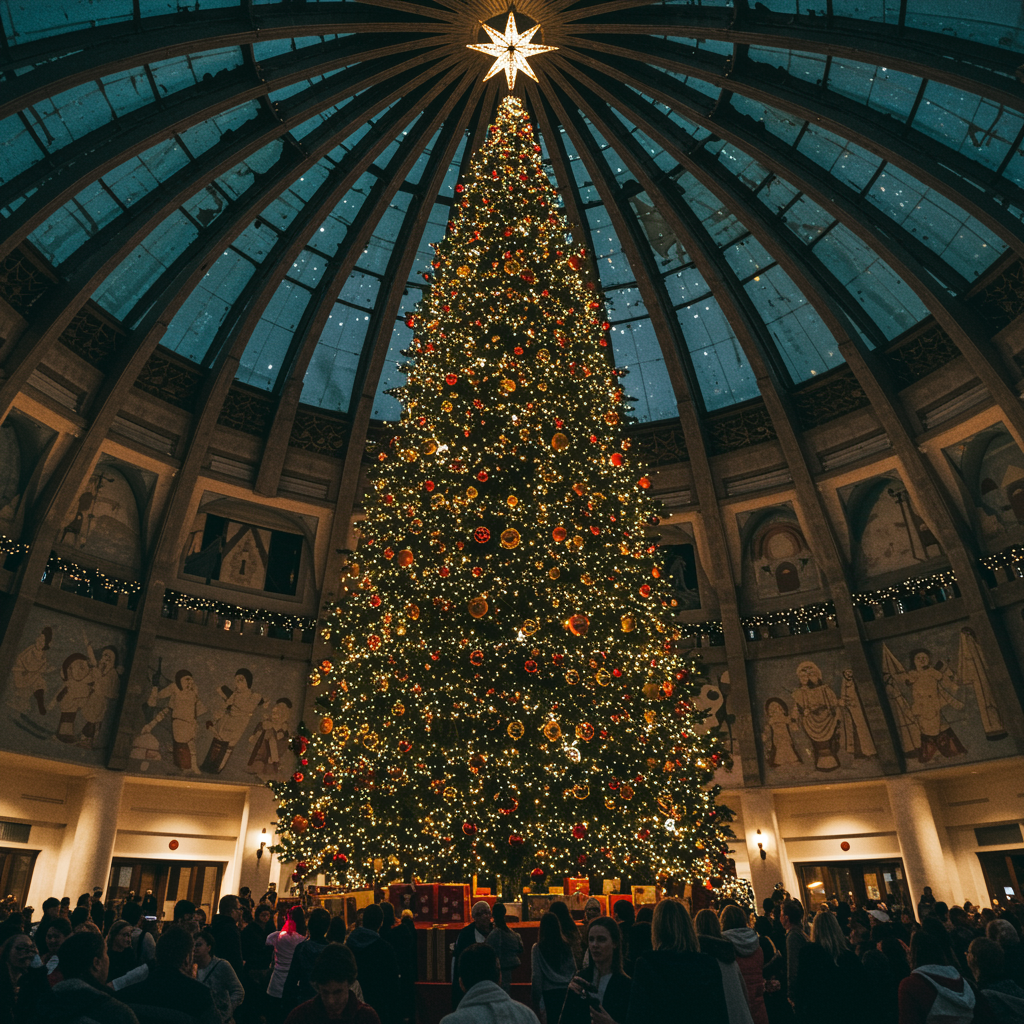
The story of the Christmas tree begins long before Christianity. Ancient cultures like the Egyptians, Romans, Celts, and Vikings used evergreen plants in their celebrations. They saw them as symbols of resilience during the darkest days of winter.
These evergreens symbolized eternal life and hope, reminding people that the sun would return after the solstice. For them, green boughs were more than decoration. They were a promise of renewal and protection against a spiritual realm they didn't understand.
Technically, these weren't actual Christmas trees. But the tradition of using trees this way did lead to the tradition of the Christmas tree.
Christian Adaptation
As Christianity spread, the story of the Christmas tree took on new meaning. It became more like what we think of as that beloved symbol of Christmas.
A famous legend tells of St. Boniface in the 8th century. As the tale goes, he cut down a pagan oak tree. As the tree fell, he pointed to a nearby evergreen as a symbol of Christ’s eternal life.
By the Middle Ages, Germans displayed Paradise trees decorated with apples on December 24, the feast of Adam and Eve. Even the great Reformer, Martin Luther, is said to have had a tree.
Martin Luther’s Christmas Tree
Tradition says Luther was the first to place candles on a tree, symbolizing Christ as the Light of the World. In the 19th century, a famous steel engraving titled “Martin Luther’s Christmas Tree” appeared. It depicted Luther with his wife Katie and their children gathered around a candlelit fir tree.
While historians debate whether Luther truly began the practice, the engraving became iconic. It visually connected the Reformation with the Christmas tree tradition. The picture reveals Luther as a family man who brought Christ-centered meaning into Christmas celebrations. This reinforced the tree as a symbol of gospel light shining in darkness.
Spread Across Europe
Germany became the cradle of the Christmas tree tradition. By the 16th century, decorated trees were common among Lutheran families.
The story of the Christmas tree spread further when Prince Albert, of German heritage, introduced the custom to England. Queen Victoria’s embrace of the tree in the 1840s made it fashionable across Britain. Soon, the practice was celebrated throughout Europe in the most festive ways.
Arrival in America
The story of the Christmas tree crossed the Atlantic with German immigrants in the early 1800s. Mark Carr opened the first American Christmas tree lot in New York in 1851. His effort made the tradition accessible to families across the country.
During the Great Depression, construction workers erected a tree at Rockefeller Center. This sparked a national tradition that continues today.
Modern Symbolism
Today, we carry on this tradition every time we put an ornament on a tree or hang tinsel on its branches. The story of the Christmas tree is told through ornaments, lights, and stars that represent the hope of Christ’s birth.
Decorations have evolved from apples and candles to dazzling displays of creativity. Even with these innovations, the meaning remains. Light has shone in the darkness of this world. People have seen a great light (Isaiah 9:2).
That light is Jesus, the Son of God (John 1:4–9).
The Real Story of the Christmas Tree
You see, although the Christmas tree is a very important symbol during the holiday season, it isn't the most important symbol. In fact, it's not even the most important tree!
Two thousand years ago, God sent His Son to this earth on the true Christmas day. His Son came to die. He was born to it.
And you know what He died on? He died on a tree. No, this wasn't a pretty one with tinsel, lights and ornaments. It didn't have presents under it. It didn't even have apples or candles!
No siree. This one was different.
This tree was a cross. It had Jesus hanging from it. It had evil men standing around under it, spitting insults at Him. And on that very tree the Son of God died, taking our punishment as He bore our sins in His own body as He hung there (1 Peter 2:24; c.f. Galatians 3:13).
So every time you look at a Christmas tree, don't see it as simply a fun thing to decorate. It's not just a symbol of the season. Remember that it demonstrates God's greatest gift of love (Romans 5:8).
God bless.

Want more Christmas? Go back to our main Christmas page.
Can't be home for the holidays? Go to the homepage instead!
Full disclosure: As an Amazon Affiliate, links to Amazon may earn Biblephoria.com a commission on qualifying purchases. This is just one of the things we do to support this cause. Thank you for your support.
Please Support Us
Your gift helps fund Biblephoria's free online courses and study materials.
Give NowRecent Articles


-
How Do I Obey God? Lesson 3
May 26, 26 08:41 PM
 How do I obey God? I mean, if I want to do it right, where do I start? Is there a right or wrong answer to this? Let's find out together.
 -
Can God Forgive My Sins?
May 19, 26 06:11 PM
Can God forgive my sins? Can He scrub away the guilt I feel and give me what I need? Forgiveness? Let's discover the answer to these questions together. -
Why Do I Feel Guilty?
May 07, 26 12:48 AM
Have you ever wondered "Why do I feel guilty?" Guilt is a constant in the human condition. But where does it come from? What takes it away? Let's find out.




Find our Privacy Policy and User Agreement here.