
Please Support Us
Your gift helps fund Biblephoria's free online courses and study materials.
Give Now- Home
- What Is Advent?
- What Are the Advent Colors
What Are the Advent Colors?
What are the Advent colors? That's a great question. Surprisingly, it isn't a cut-and-dry question. It's much deeper than that.
We'll talk about that in just a moment. But before we do, we wanted to mention that we've posted an Advent Calendar at the bottom of this page to show the dates of Advent and the meaning of each traditional candle color. Feel free to use it as you wish.
And now, let's answer the question we posed at the beginning. What are the Advent colors? And what do they mean?
A Short History of Advent
Advent comes from the Latin word *adventus*, meaning “coming” or “arrival.” From the earliest centuries of the church, Christians set aside the weeks before Christmas as a season of preparation and expectation.
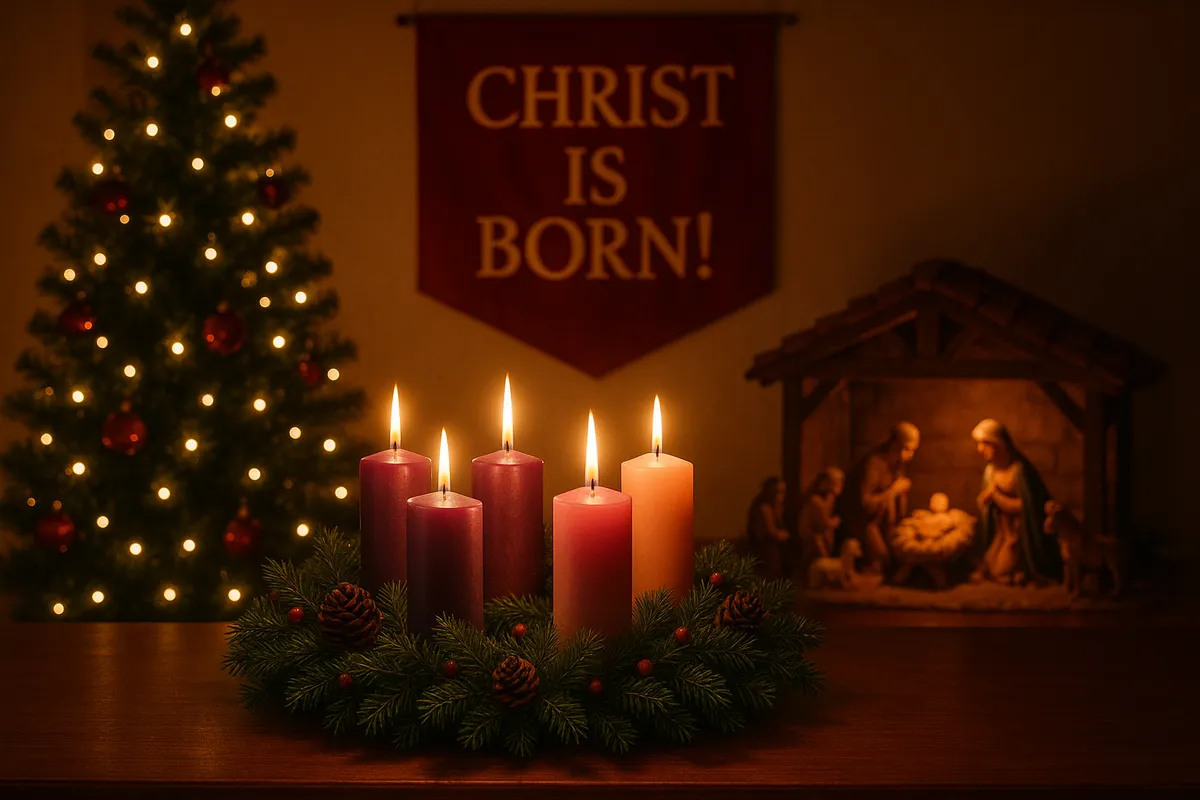
In Western tradition, Advent begins on the fourth Sunday before Christmas and continues until Christmas Eve. It is both a remembrance of Christ’s first coming in Bethlehem and a hopeful anticipation of His promised return. It informs us about the true meaning of Christmas -- Jesus Christ.
Originally, Advent was observed with fasting and repentance, much like Lent. Scripture readings emphasized themes of watchfulness, turning from sin and longing for God’s kingdom. Over time, the season became more joyful, focusing on hope, peace, joy, and love. By the Middle Ages, Advent was firmly established as the beginning of the liturgical year. It shaped the rhythm of Christian worship across Europe.
Early Christians began using wreaths to celebrate the holidays. Of course, this included the Advent wreath. It first appeared in Germany and became a central symbol of the season.
Its circle represents eternity. Its candles mark the four Sundays leading up to Christmas, most often, three purple, one pink and one white. As the weeks progress, the light grows brighter. This is to remind believers of Christ—the Light of the World—drawing near.
Advent Calendar
Advent Traditions and Colors
What are the Advent colors? Here they are in...er...living...color. Oh, never mind. Here they are:
Purple (Royal or Penitential)
Purple has long been the dominant color of Advent in Western Christianity. It symbolizes royalty, pointing to the coming of Christ the King. It also symbolizes penitence, reminding believers to prepare their hearts through repentance. This connection to Lent underscores the seriousness of the season, even as it anticipates joy. Churches using purple often highlight themes of hope, peace, and love across the four Sundays.
Pink (Rose)
The pink candle is reserved for the third Sunday of Advent, known as Gaudete or Rejoice Sunday. Its lighter tone breaks the somberness of purple, signaling joy as Christmas draws near. This tradition emphasizes that even in a season of watchfulness and repentance, the believer’s anticipation is filled with gladness. The pink candle is often associated with the theme of joy.
Blue (Sarum Rite)
In some Anglican and Lutheran traditions, deep blue replaces purple. This practice comes from the Sarum Rite, a medieval English liturgical tradition. Blue emphasizes hope and expectation rather than penitence. This shifts the focus toward the coming dawn of Christ’s light. It is a reminder of Mary’s role in the Advent story, as blue is often associated with her in Christian art.
White (Christ Candle)

Many Advent wreaths include a central white candle, lit on Christmas Eve or Christmas Day. White represents purity, light, and the glory of Christ’s birth. It completes the wreath, symbolizing that the long-awaited Messiah has come into the world. The Christ candle is often larger than the others, standing at the center as the culmination of Advent’s anticipation.
More than anything, this candle symbolizes that Christ is the true reason for the season.
What Are the Advent Colors You Chose?
Purple seems to be the dominant tradition. But if you'd rather use blue, that's okay. Go right ahead!
In our church, we use a set of three purple candles and one pink candle on the Advent wreath with the white "Christ Candle" in the middle. This balance reflects both the solemn preparation and the joyful anticipation of Christ’s coming. I like it best because it reminds us that we are sinners in need of a Savior. It reminds us why Christ came in the first place -- to die on a cross and wash us clean in His blood.
How to Observe Advent (Quick Guide)
Here's a concise guide to celebrating Advent:
- Light one candle each Sunday of Advent, beginning four Sundays before Christmas.
- Use three purple candles (Hope, Peace, Love) and one pink candle (Joy, Gaudete Sunday).
- Read a short Scripture passage and pray as you light each candle.
- Reflect on the weekly theme: Hope, Peace, Joy, Love.
- On Christmas Eve or Christmas Day, light the central white “Christ candle” if included.
What Are You Going to Do With This?
We started off this conversation with the question, "What are the Advent colors?". Let's end with an even more important question:
What are you going to do with this?
Oh, sure. You don't HAVE to celebrate Advent. But why wouldn't you want to do anything you could to remind yourself of why Jesus came? That little baby, born in a barn, came to die and save us from our sins. The least we can do is use every tool at our disposal to remind ourselves of our Suffering Savior and Conquering King.
Advent is there to teach us to glorify God to the fullest. Let's use every opportunity to glorify God (1 Corinthians 10:31, Colossians 3:17).
Soli Deo Gloria!

Want more Advent. Go back to our main Advent page.
I'll be home for Christmas. But that doesn't mean you can't go back to the homepage!
Full disclosure: As an Amazon Affiliate, links to Amazon may earn Biblephoria.com a commission on qualifying purchases. This is just one of the things we do to support this cause. Thank you for your support.
Please Support Us
Your gift helps fund Biblephoria's free online courses and study materials.
Give NowRecent Articles


-
How Do I Obey God? Lesson 3
May 26, 26 08:41 PM
 How do I obey God? I mean, if I want to do it right, where do I start? Is there a right or wrong answer to this? Let's find out together.
 -
Can God Forgive My Sins?
May 19, 26 06:11 PM
Can God forgive my sins? Can He scrub away the guilt I feel and give me what I need? Forgiveness? Let's discover the answer to these questions together. -
Why Do I Feel Guilty?
May 07, 26 12:48 AM
Have you ever wondered "Why do I feel guilty?" Guilt is a constant in the human condition. But where does it come from? What takes it away? Let's find out.





Find our Privacy Policy and User Agreement here.