
Please Support Us
Your gift helps fund Biblephoria's free online courses and study materials.
Give Now- Home
- What Is in the Bible?
- How Was the Earth Created?
How Was the Earth Created?
How was the Earth created? Did it just pop into existence? Did it spawn from a micro-singularity that (for reasons unknown to us) suddenly expanded and blew up?

For a very long time, human beings have wrestled with the question, "How was the Earth created?" That's the exact topic we will tackle here.
The question of how the Earth was created has stirred minds for centuries. Scientists, philosophers, and believers alike have sought answers, each bringing unique insights.
We'll start by painting a picture with very wide strokes as we study the facts that have led us here. Then we'll add some finer details to the picture as we jump into the good stuff: what the Word of God says.
There's a carousel below to help you navigate the contents of this page. We also created a chart of scientists who believed in God.
Also, make sure to take the quiz at the end to help you remember the content better. We hope that these will help as well.
Ready? Okay. Let's go.
Scientists of Faith
Newton, Kepler, Pasteur — pioneers who saw God’s hand in discovery.
Spontaneous Generation
Once accepted, disproven by Pasteur: life comes only from life.
Evolution & Parallels
Natural processes proposed, raising questions of design and purpose.
Intelligent Design
Complexity and order in nature point to a purposeful Creator.
Genesis 1
God speaks creation into existence — light, land, life, humanity.
Genesis 2
Focus on humanity, the garden, and God’s intimate role in life.
Supporting Passages
Psalm 33, Isaiah 45, John 1, Hebrews 11 — affirming God as Creator.
Answering the Question: How Was the Earth Created?
Scientists Who Believed in God
Too often, the argument goes something like this: "But science doesn't support the Bible, so scientists shouldn't support the way the Bible says the Earth was created." Is this assumption true?
Many of history’s greatest scientific minds saw no conflict between science and faith. They understood that "religion" and science walked together hand-in-hand like best friends.
This stands in contrast to the modern conception that religion is personal and science is universal. Because of this, some believe that those two disciplines don't mix. They're completely different.
Let's look at a few examples from history who believed otherwise.
- Nicolaus Copernicus was a faithful Catholic who served as a church canon while developing his groundbreaking heliocentric theory. Far from opposing the Church, he remained loyal to Catholic teaching. His model of the sun at the center of the universe was framed as uncovering the harmony of God’s creation, not as a challenge to faith. For Copernicus, studying the heavens was a way of honoring the Creator and revealing divine order.
- Isaac Newton marveled at the order of creation. Was he a real Christian? Only God knows that. He certainly held some odd beliefs that weren't clearly biblical. What we do know is that he firmly believed in a God who created things and stayed involved. Newton wrote extensively on religious matters.
- Johannes Kepler described science as “thinking God’s thoughts after Him.” He stood strong in his faith, even when those who should have supported him didn't. He believed in a God who is personal and interested. He was a true Christian, ultimately losing almost everything because he loved Jesus.
- Louis Pasteur was a Catholic who defended the idea of divine design while dismantling false theories. He was a very religious man, a fact demonstrated in his scientific work. His faith augmented his scientific pursuits rather than hindering them.
These men remind us that faith and science are NOT mutually exclusive. They aren't at each other's throats. When both are treated fairly, they actually get along pretty well.
| Scientist | Faith Orientation | Key Beliefs | Relationship to Science |
|---|---|---|---|
| Nicolaus Copernicus | Faithful Catholic canon | Loyal to Church, opposed Reformation, saw science as uncovering divine order | Heliocentric theory framed as revealing God’s harmonious creation |
| Isaac Newton | Devout but heterodox Protestant | Rejected Trinity, believed in God as active Creator, studied prophecy and church history | Saw science as confirming belief in God; wrote theology privately |
| Johannes Kepler | Committed Lutheran Christian | Christ-centered, orthodox faith; intended to be a minister | Saw astronomy as “thinking God’s thoughts after Him”; science as worship |
| Louis Pasteur | Devout Catholic | Amazed by Creator, trusted God through trials | Science as service to God and humanity |
Spontaneous Generation
For centuries, people believed life could arise from non‑life. This theory is called spontaneous generation. The scientific authorities of the time clung strongly to this belief.
Finally, experiments by Louis Pasteur demonstrated that life comes only from life. This turning point reshaped scientific thought and opened new debates about origins. It also established an important fact in the biblical record (Genesis 1:21; Genesis 1:25; c.f. Genesis 6:20; Genesis 7:14).
Evolution and Its Parallels
Modern evolutionary theory proposes that life developed gradually through natural processes. Speculation on what started the process varies wildly. Some believe it all began when a micro-singularity (think mini black hole) that suddenly expanded, producing the "Big Bang." In other words, inanimate matter ultimately produced life.
While distinct from spontaneous generation, evolution falls into the same trap. How can life come from non-life? If evolution could explain that one mechanism, it would be science. It doesn't. So it remains theory.
In addition, evolution hits all kinds of moral and ethical issues. If life is mechanistic and based on survival of the fittest, where does morality come from? Why does man have something no animals have? A spark of awareness animals don't? Evolution not only can't answer these questions, but it also creates problems that prohibit it from offering an answer.
This theory raises important questions about meaning, purpose, and design. The issue is that it starts with the wrong source.
Intelligent Design
The concept of intelligent design (ID) argues that the complexity and order found in nature point to a purposeful designer and creator. ID attempts to explain the origin of the universe by presenting consistent design rather than a random-chance theory as the reason behind everything that exists.
It falls short in that it opens the door for any creator. It doesn't define the source of creation. It simply assumes some kind of creator exists.
Despite this fault, it does raise one really good question: if the universe shows design, who designed it? In other words, it asks the same question we have posed:
How was the Earth created?
From the fine‑tuned laws of physics to the intricate structures within living cells, intelligent design highlights patterns that suggest intentional design and creation. Something can't come from nothing. Science has proven that.
While not a substitute for Scripture, it provides a bridge between scientific observation and faith. This allows it to affirm beliefs that evolution just doesn't allow--God is the ultimate Designer and Creator behind everything (Colossians 1:16).
How Was the Earth Created? Biblical Evidence of Divine Creation
So how does the Bible answer the question, "How was the Earth created?" Let' find out.
Genesis 1
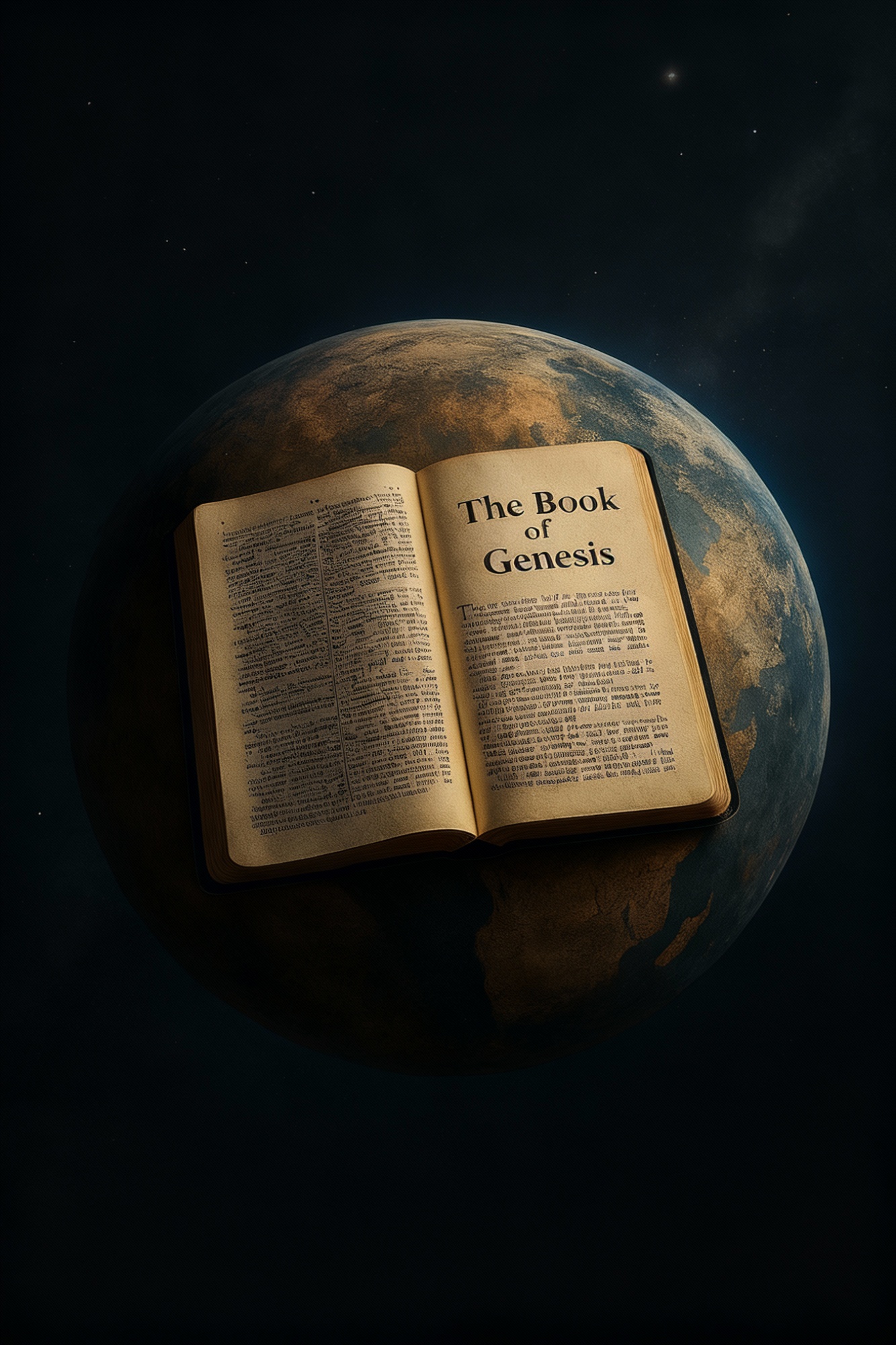
This is where it all starts. What better place to begin than the very beginning?
So where does the Bible say it all came from? It came from God, of course.
God speaks the world into existence, forming light, land, seas, plants, animals, and humanity in six literal days. God creates a world that is orderly, purposeful, and declared “very good.”
He inserts Himself into the narrative right from the beginning. By doing so, He becomes the narrative. God initiates and completes creation.
This is the reason why so-called theistic evolution is so devious. Theistic evolution seeks to marry evolution with the biblical narrative. It does this by saying God started the creative process, but then allowed everything to evolve over time.
But that can't be. The biblical narrative in Genesis 1 shows a God who fully engages Himself in the process. Our God is an involved God, not a God who evolves things.
He speaks. It appears. That's it.
Genesis 2
Contrary to what some try to establish, this isn't an "alternate" creation story. The narrative zooms in on humanity, describing Adam and Eve, the garden, and God’s intimate role in shaping life.
Genesis 1:27 clearly communicates the facts. God created male and female on day six. If we take this text at its word, the events of Genesis 2 happened sometime during that 24-hour period.
Some see details in Genesis 2 that aren't compatible with what Genesis 1 says. Here's the simple answer. People will see what they want to see. With that said, we need only take God at His Word that all the details work.
God created everything just like He tells us in Genesis 1 and 2.
Supporting Passages
But wait! There's more!
There are other passages that emphasize God's conscious, creative acts. The whole Bible calls creation an intentional act of God:
- Psalm 33:6–9 — God’s word brings creation into being.
- Isaiah 45:12 — God formed the earth and mankind.
- John 1:1–3 — Christ, the Word, is the agent of creation.
- Hebrews 11:3 — By faith we understand the universe was formed by God’s command.
Together, these passages affirm that creation is not random but the deliberate work of a loving Creator.
Answering the Question: How Was the Earth Created?
So how was the Earth created? Some attempt to explain it through simple mechanical processes, making the creation God. Scripture reveals the Author who created the mechanism we call creation.
The earth was not an accident. It was spoken into existence by God. It shows design because it has a Designer. It looks created because it has a Creator.
A More Important Creation
If we stop here, we stop short of a truth even greater than the original creation. There's another creation, a re-creation, that we can experience now.
You see, shortly after God created everything, human beings accepted a lie from the mouth of Satan (Genesis 3:1-7). This plunged the whole human race into sin (Romans 3:23).
The creation was marred. It was damaged beyond anyone's capacity to fix it.
Anyone's but God, that is.
The God who created everything sent His Son, Jesus Christ, to fix it all (Colossians 1:19–20). We human beings who started the slide are those on whom the greatest salvation lies (Colossians 1:21–22).
When we believe in faith, we become part of the new creation. God makes everything new through Jesus Christ (2 Corinthians 5:17; c.f. Revelation 21:5).
God created it.
We destroyed it.
Christ makes it all right again.
So the most important question you can ask isn't, "How was the Earth created?" The most important question you can ask is, "Have I been made part of the NEW creation?"
If you haven't made yourself a part of God's new creation, do that today. Believe in faith in Jesus Christ. It's the most important decision you will ever make. Put your trust in Jesus Christ alone.
God bless you in this pursuit.
Take the Quiz!
Creation Quiz

Go back to find more of what's in the Bible.
Is your home your castle? Then you'll like the homepage!
Full disclosure: As an Amazon Affiliate, links to Amazon may earn Biblephoria.com a commission on qualifying purchases. This is just one of the things we do to support this cause. Thank you for your support.
Please Support Us
Your gift helps fund Biblephoria's free online courses and study materials.
Give NowRecent Articles


-
How Do I Obey God? Lesson 3
May 26, 26 08:41 PM
 How do I obey God? I mean, if I want to do it right, where do I start? Is there a right or wrong answer to this? Let's find out together.
 -
Can God Forgive My Sins?
May 19, 26 06:11 PM
Can God forgive my sins? Can He scrub away the guilt I feel and give me what I need? Forgiveness? Let's discover the answer to these questions together. -
Why Do I Feel Guilty?
May 07, 26 12:48 AM
Have you ever wondered "Why do I feel guilty?" Guilt is a constant in the human condition. But where does it come from? What takes it away? Let's find out.




Find our Privacy Policy and User Agreement here.