
Please Support Us
Your gift helps fund Biblephoria's free online courses and study materials.
Give Now- Home
- Free Online Bible Study Courses
- Why Do Bad Things Happen?
- Why Do People Get Sick?
Why Do People Get Sick?
Lesson 3 -- Why Do Bad Things Happen?
(Bite-Sized Bible Course)

So why do people get sick? Has it always been this way? Has life on this ball of clay always sported viruses and bacteria that create sickness?
Or is there more to the story?
That's what we're looking at today in our final lesson on Why Do Bad Things Happen? But first, just a reminder to complete the quiz at the bottom before you leave. It's important because it will press your memory and help you absorb more of what you read.
Ready? Let's dive into the question: Why do people get sick?
Why do people get sick?
What question could get our attention faster than this? I mean, no one enjoys suffering from the common cold or recovering from a broken bone. Why do we get sick?
Here's the simple truth.
This world wasn't always this way. We get sick because we live in a fallen world where sin has brought real damage into every part of life, including our bodies (Genesis 3:16-19; Romans 5:12). Since Adam's sin, we struggle with sickness, serious injury and death.
Let me clarify one point before we move on. I'm not saying that every illness is tied to a specific personal sin. Scripture warns us not to make that assumption too quickly (John 9:1-3).
What I am saying is that original sin ruined creation. It brought sin and death to everyone. That's why we see what we do. That doesn't mean every case of illness is identical. What it does mean is that sickness belongs to the broken condition of the world we now inhabit (Romans 8:20-23).
You see, God made the human body good. After the Fall, sickness, weakness, decay, and death became part of our shared experience. That kind of suffering is standard for us. In fact, it's so standard that some even feel that it's always been that way.
But that simply isn't true. God's creation was good. We spoiled it back there in the Garden of Eden (Genesis 3:1–7).
Let's look a little closer at the problem.
The World Is Broken

When Adam sinned, the whole creation fell apart. Human life entered a new reality marked by pain and death (Genesis 3:17-19; Romans 8:20). Disease is one of the many ways that brokenness shows up in ordinary life. Even when people can't trace a clear cause, the Bible teaches us to see sickness as part of the larger curse that affects the world.
That's why we shouldn't be surprised when strong bodies grow weak. Life shows us that youth gives way to old age and decline. When children and the healthy become sick, we discover sin's fingerprints all over the crime scene.
The created order is still good in many ways. It's still God's masterpiece. The fact is, it's not fully restored (Romans 8:22–23). We live between the goodness of creation and the fullness of final redemption.
Sickness and the Problem of Sin
Jesus corrected the idea that suffering always points to a specific sin in the person who suffers. When His disciples asked about a man born blind, Jesus said it wasn't the direct cause of that man or his parents. Although sickness is a result of sin, in this case, no one had sinned in some special way to bring about sickness in the man (John 9:1-3).
That doesn't mean sin is irrelevant to sickness. If James is speaking literally, he explains sickness can be a direct result of sin (James 5:13–15). In some cases, sickness may be connected to foolishness, neglect, or direct consequences of sinful choices (Proverbs 14:30; 1 Corinthians 11:29-30).
In other cases, illness simply reminds us that we are mortal creatures in a fallen world. Either way, the right response is not suspicion or blame, but compassion, prayer, and trust in God. Sometimes, it's simply all about God's glory (John 9:3).
God's Purpose in Sickness
God is never absent when His people are sick. He rules over illness. He uses it wisely and can bring good from suffering even when we cannot see it right away (Romans 8:28).
Why would God do this? Sometimes, sickness humbles us, slows us down, or turns our hearts back toward what is eternal.
Sickness can also remind us that we are not self-sufficient. We like to think we are strong, but illness exposes our weakness quickly. In that way, pain can become a mercy if it drives us to prayer, dependence, and deeper hope in the Lord.
The fact is, good or bad, everything works for His glory and power. The Bible includes sickness in this.
Jesus healed many who were sick. In doing so, He proved that He had authority over disease and bodily weakness (Matthew 4:23-24). Those miracles were signs that the kingdom of God had come near.
A greater healing was on the way.
Our Hope in Christ Alone
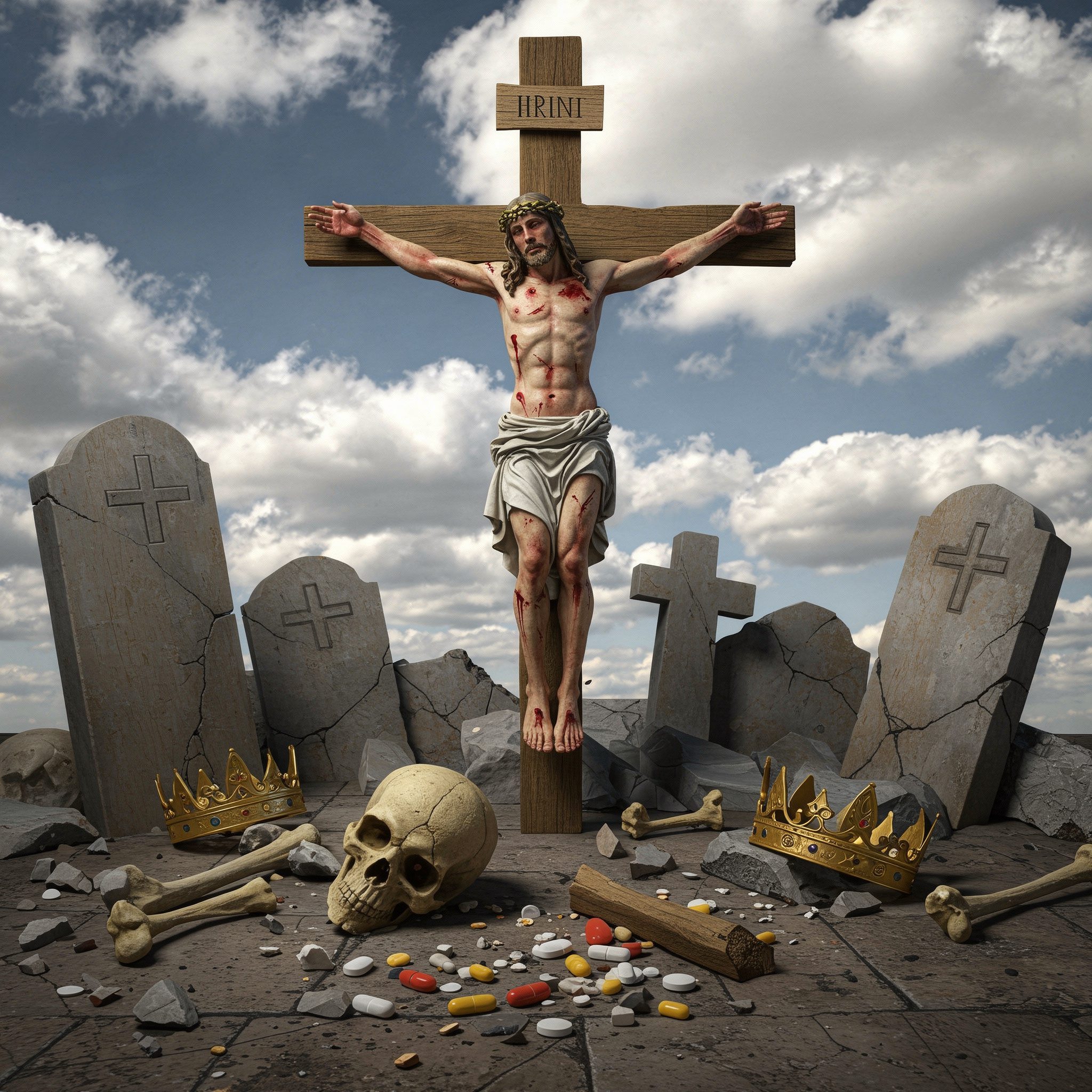
The deepest answer to sickness is not merely medicine. Medicine works in some cases. It's a gracious gift from God that He gave us to temporarily battle sickness.
However, there's something much more important to understand. The deepest answer is Jesus Christ. He came into our broken world, took on human flesh, bore our griefs, and carried our sorrows (Isaiah 53:4-5; Matthew 8:16-17). He entered the suffering of this world to redeem His people from sin, death, and the curse.
For believers, sickness is temporary. In Christ, we are promised resurrection bodies, perfect bodies, lived out in a world where pain and death will be gone forever (1 Corinthians 15:42-44; Revelation 21:4).
That hope doesn't deny present suffering. Not at all. It gives suffering a horizon.
We aren't delusional. We don't pretend sickness is good. We do believe God is good in the middle of it.
So why do people get sick? Because this world is fallen. Because bodies are fragile. Because creation is still waiting for final renewal. Yet for the Christian, sickness is never the end of the story.
Christ is.
If Christ isn't the end of your story, believe in Him today. Unyielding faith in Christ will always bring a happy ending.
God bless.
Lesson Quiz: Why Do People Get Sick?
Test what you’ve learned about sickness, the Fall, the broken world, and our hope in Christ.
Bible
Course

This is it! Here are more Bite-Sized Bible courses!
Click here to go to the homepage.
Full disclosure: As an Amazon Affiliate, links to Amazon may earn Biblephoria.com a commission on qualifying purchases. This is just one of the things we do to support this cause. Thank you for your support.
Please Support Us
Your gift helps fund Biblephoria's free online courses and study materials.
Give NowRecent Articles


-
How Do I Obey God? Lesson 3
May 26, 26 08:41 PM
 How do I obey God? I mean, if I want to do it right, where do I start? Is there a right or wrong answer to this? Let's find out together.
 -
Can God Forgive My Sins?
May 19, 26 06:11 PM
Can God forgive my sins? Can He scrub away the guilt I feel and give me what I need? Forgiveness? Let's discover the answer to these questions together. -
Why Do I Feel Guilty?
May 07, 26 12:48 AM
Have you ever wondered "Why do I feel guilty?" Guilt is a constant in the human condition. But where does it come from? What takes it away? Let's find out.





Find our Privacy Policy and User Agreement here.