
Please Support Us
Your gift helps fund Biblephoria's free online courses and study materials.
Give Now- Home
- Free Online Bible Study Courses
- Jesus' Words from the Cross
- Jesus' Words from the Cross: Final Exam
Seven Last Words of Christ Reviewed
Final Exam -- Jesus' Words from the Cross
(Bite-Sized Bible Course)
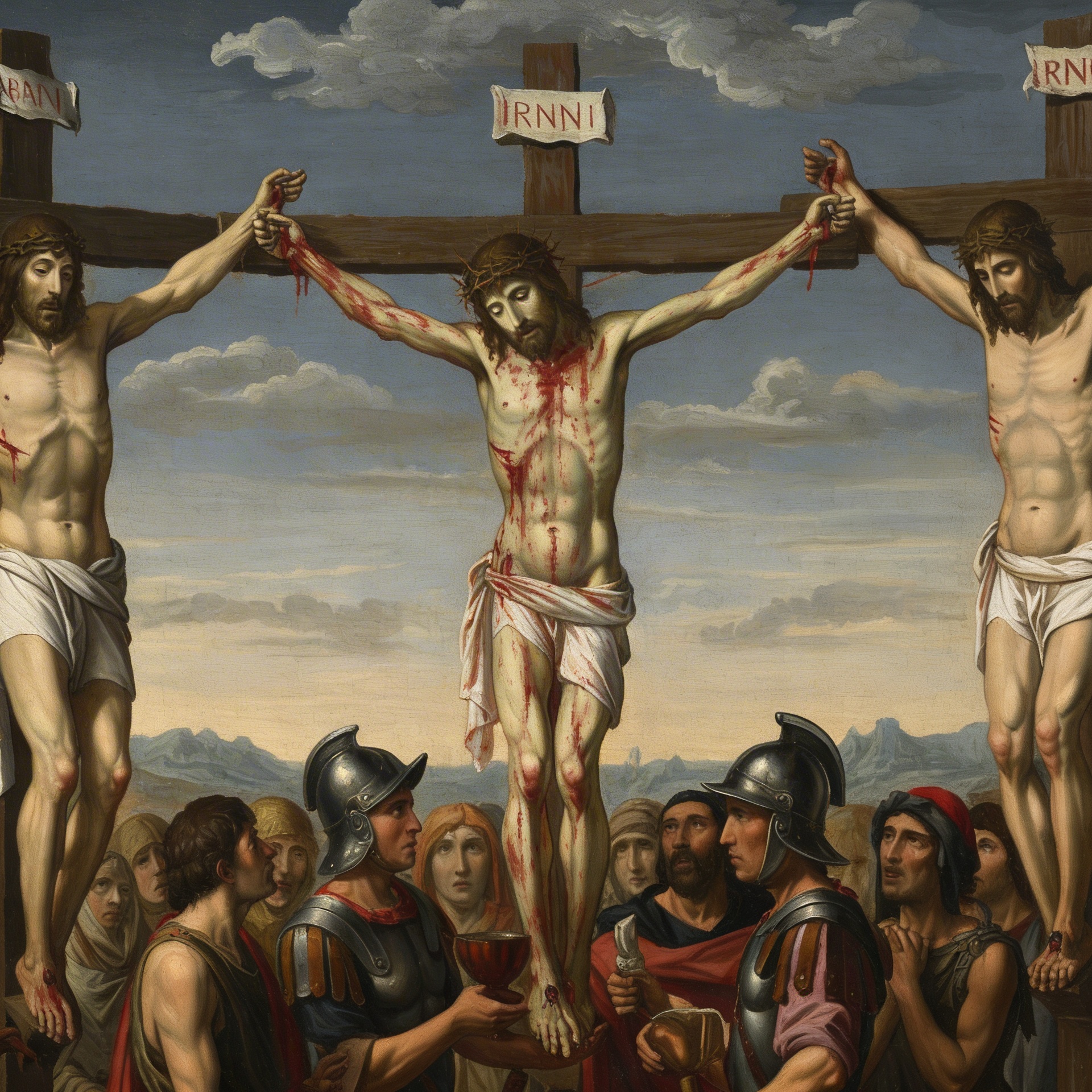
So, you've done the last lesson in our Jesus' Words from the Cross. If you've completed the whole study on the seven last words of Christ, congrats!
We appreciate you sticking with it!
Before we move on, don't forget to take the Final Exam at the end. But let's review a little first. That's what this page is for. We want you to remember as much as possible so that you can do your best on the Final Exam.
Let's do this!
Jesus' Words from the Cross -- Lesson Review
Father, Forgive Them
In the first of the seven last words of Christ from the cross, Jesus doesn't cry out in rage or self‑pity, but prays for His Father to forgive those around (Luke 23:34). While soldiers gamble for His clothing and leaders and crowds mock Him, He asks the Father to forgive the very people who nailed Him to the cross.
This prayer exposes the depth of human sin. It also demonstrates the greatness of Christ’s mercy, as He bears the griefs, sorrows, and guilt foretold in Isaiah 53.
Calling God “Father” even here reveals unbroken trust in the One who is allowing Him to suffer injustice. Those around the cross don't understand that they are crucifying the Messiah. Yet Jesus intercedes for them and everyone else throughout time who has sinned (Romans 8:34; Hebrews 7:25).
His first word becomes a pattern for forgiven sinners. Those who have been forgiven much are called to forgive others “as the Lord has forgiven you” (Colossians 3:12–13).
Today You Will Be with Me
As Jesus dies between two criminals, we discover two very different responses to the crucified King (Luke 23:39–43). One thief continues to mock and demands escape without repentance. The other? He places his soul in the Savior's care with a simple plea: “Remember me when You come into Your kingdom.”
He has nothing to offer. No time left to repair his life. Yet he sees Jesus as a righteous King who can save even at the point of death.
Jesus’ promise, “Today you will be with Me in paradise,” paints a vivid picture of salvation by grace through faith alone. A lifetime of guilt meets a last‑minute, Spirit‑wrought honesty about sin and trust in Christ.
The Savior's response? He freely welcomes him. This story should never be used to excuse delay, but it shows it's never too late to turn to Christ in this life.
Behold Your Mother
When the focus shifts to those standing near the cross, John’s Gospel shows a small cluster of women, Mary with them. The disciple whom Jesus loved is also there (John 19:25–27). From the cross, Jesus addresses His mother and John.
“Woman, behold your son… Behold your mother.” Even in agony, He keeps the command to honor His father and mother by providing for Mary’s future through John. In this way, He creates a new kind of family at the foot of the cross.
In this word, Christ shows that those gathered around Him are more than spectators. They are knit into a community defined by His care. The lesson challenges believers to see one another as God‑given family in Christ and to express that reality in practical, sacrificial care.
Why Have You Forsaken Me?
In the darkest moment, Jesus cries with a loud voice, “My God, My God, why have You forsaken Me?” (Matthew 27:45–46; Mark 15:33–34). He is quoting the opening line of Psalm 22. By doing this He is identifying Himself with the righteous sufferer who is abused in ways that fit the crucifixion.
This cry doesn't mean the Trinity breaks apart. The eternal love of Father and Son stands even as the Son bears the judgment our sin deserves.
This is all about substitution. For whom? For us.
The sinless Son stands in the place of guilty sinners as He drinks the cup of God’s wrath for us. This word also provides language for believers who feel abandoned. It in invites them to bring their “why” to God instead of hiding it.
The cry is not the end of the story. God raised Jesus and seated Him at His right hand, where He now intercedes for those who come to God through Him (Hebrews 7:25).
I Am Thirsty
Jesus says He is thirsty. Imagine that! Jesus is God. God is thirsty! This is one of the most interesting of the seven last words of Christ from the cross.
But He isn't saying this simply because He wants something to drink. It's to fulfill what the Bible said about Him. All He gets from the soldiers is sour wine (John 19:28–29).
We find the exact details in the psalms. This shows that even small moments at the cross unfold according to God’s faithful plan (Psalm 22; Psalm 69). He's fully human, even feeling pain and suffering.
At the same time, this word links back to Jesus’ invitation for all to come and drink of His living water through the Spirit (John 7:37–39). Weary believers aren't told to hide their dryness or simply try harder. They must come again and again to the crucified and risen Lord who satisfies deeper than any “broken cisterns” of sin or temporary comfort (Jeremiah 2:13).
Sometimes there's great importance in small details.
It Is Finished

When Jesus cries, “It is finished,” we see that this isn't a sigh of defeat. It's a triumphant declaration. It's one word in the Greek text: tetelestai, “it has been accomplished” (John 19:30).
Jesus is fully aware and in control. He bows His head and gives up His spirit only after completing the work the Father gave Him to do. The word picture is that of a bill stamped “paid in full” or a task brought to completion. Simply put, it signals that the work of salvation is done and nothing remains to be added.
What can we learn? Christ brings comfort and freedom to all who come to Him. In Him there is no remaining wrath for those who belong to Him, no works necessary, and no need to earn God's favor (Romans 8:1).
Obedience isn't leverage to pry love from God. It's the grateful effort of a child already loved, resting in finished work and responding with trust and thankful service.
This is one of the most comforting of the seven last words of Christ from the cross. Christ finished it all for us.
I Commend My Spirit
Just before death descends on Him, Jesus again calls to His Father. He says, “Into Your hands I commend My spirit.” He cries out with a loud voice.
Then He dies (Luke 23:46).
This is willing surrender, not forced collapse. He entrusts Himself to the Father’s hands as an act of confident faith as He echoes Psalm 31:5. God’s hands picture power, protection, and care. This prayer portrays death not as a plunge into chaos but as a conscious placing of Jesus' life into the Father’s keeping.
Those same hands hold the lives and futures of all who are in Christ, guarding their salvation and carrying them through suffering and death (John 10:28–29). Stephen is a good example of a believer who echoed Christ's sentiment perfectly (Acts 7:59).
“I commend my spirit” isn't only a dying prayer but a daily pattern. Each day, no matter what comes, we are invited to renew our confidence in the Father’s care. To do this, we must surrender control and rest in the One who has already passed through death and risen again.
What Should We Do with the Seven Last Words of Christ?
So how should we respond to these seven last words of Christ? How should this change our lives?
Simple. Model Christ.
- If people abuse us, forgive. If we have responsibilities, fulfill them.
- When we can't feel God's hand, we must trust His heart.
- When things feel like they're spiraling out of control, we must commend our whole selves to God, knowing He knows best.
At the end of it all, we must trust God. He will never fail us, even on the worst day. Trust God.
God bless.
Final Exam: Jesus’ Words from the Cross
Test what you’ve learned from all seven sayings of Jesus from the cross, from His prayer for forgiveness to His final surrender into the Father’s hands.
from the
Cross

That's it! Find more course here!
Let's go home. Here's the homepage.
Full disclosure: As an Amazon Affiliate, links to Amazon may earn Biblephoria.com a commission on qualifying purchases. This is just one of the things we do to support this cause. Thank you for your support.
Please Support Us
Your gift helps fund Biblephoria's free online courses and study materials.
Give NowRecent Articles


-
How Do I Obey God? Lesson 3
May 26, 26 08:41 PM
 How do I obey God? I mean, if I want to do it right, where do I start? Is there a right or wrong answer to this? Let's find out together.
 -
Can God Forgive My Sins?
May 19, 26 06:11 PM
Can God forgive my sins? Can He scrub away the guilt I feel and give me what I need? Forgiveness? Let's discover the answer to these questions together. -
Why Do I Feel Guilty?
May 07, 26 12:48 AM
Have you ever wondered "Why do I feel guilty?" Guilt is a constant in the human condition. But where does it come from? What takes it away? Let's find out.





Find our Privacy Policy and User Agreement here.