
Please Support Us
Your gift helps fund Biblephoria's free online courses and study materials.
Give Now- Home
- Free Online Bible Study Courses
- Jesus' Words from the Cross
- Father, Forgive Them
"Father, Forgive them." Divine Forgiveness Demonstrated
Lesson 1 -- Jesus' Words from the Cross
(Bite-Sized Bible Course)
"Father, forgive them; they don't know what they're doing." (Luke 23:34)
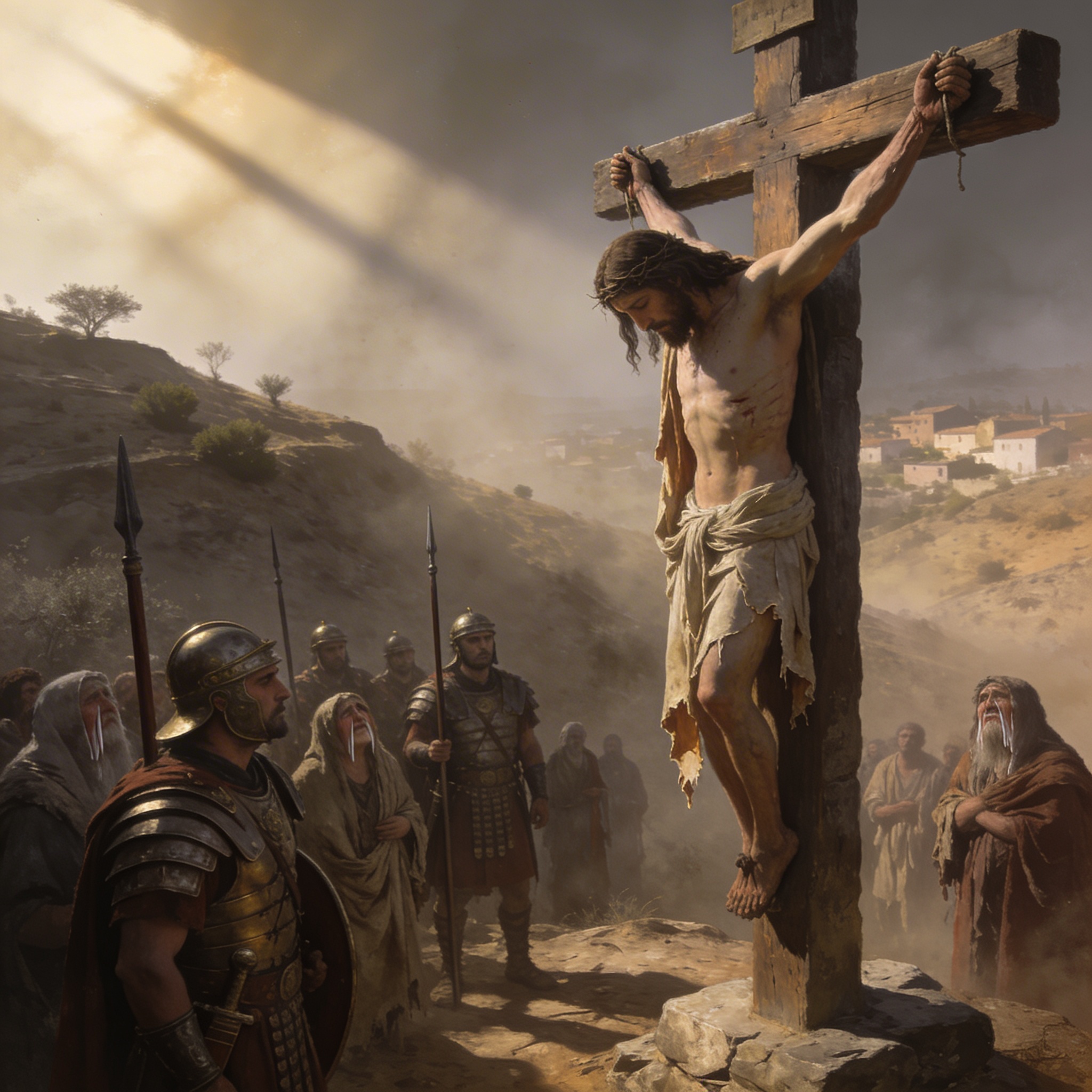
As soldiers dropped the cross into place, Jesus' first recorded words from Calvary are not cries for relief. He utters no shouts of anger, but a prayer for forgiveness.
Why? Why would a human being react with forgiveness rather than rage and bitterness?
In this lesson, we'll stand at the foot of the cross and listen carefully to that prayer. As we do, we'll see both how serious our sin really is and how generous God's mercy is in Christ.
And along the way, we'll consider what it means to forgive others the way we have been forgiven.
Before we do that, let's remember that there's a quiz at the end of this lesson. Don't forget to take it. It will really help you remember the content better.
And now, the main attraction.
Setting the Scene at the Cross
Luke tells us that Roman soldiers led Jesus to the place where He would die (Luke 23:32–33). They knew what they were doing. They were professionals and efficient.
Meanwhile, what were people doing around the cross? Soldiers gambled for Jesus' clothing. The religious leaders sneered. The crowds looked on, some curious, some hostile, some grieving (Luke 23:33–35).
At this very moment, Jesus speaks His first words from the cross. It isn't a curse. It isn't judgement. It's forgiveness. Let's look a little closer.
Why "Father, Forgive Them" Matters
People's last words often reveal what lies deepest in their hearts. Here, as Jesus hangs between earth and heaven, what pours out of Him isn't bitterness. He offers intercession.
He addresses God as "Father." Even in a tight spot, Jesus trusts His Father. He asks for "forgiveness," not revenge. He prays for "them." This isn't just some vague utterance from a dying man. He intercedes for the very people driving the nails and mocking His name (Luke 23:34).
Why does this matter? It shows us why Jesus went to the cross in the first place. He didn't come simply to set an example of love or to expose human evil. He came to secure forgiveness for real sinners by His real blood (Matthew 26:28; Ephesians 1:7).
On the cross, Jesus isn't only praying for forgiveness. He's also providing the sacrifice that makes forgiveness possible. His first word makes that purpose plain. The cross is really about God reconciling sinners to Himself through His Son.
So Who Is "Them"?
So who does "Father, forgive them," include? The most obvious "them" includes the Roman soldiers, the religious leaders, and the hostile crowd.
Let's consider a few facts. The soldiers are simply "doing their job." But does that really make them innocent.
The leaders have pushed for this outcome. They mock Jesus even as He suffers (Luke 23:13–25, 35).
The crowds shouted "Hosanna," for this man at one point. Now they cry, "Crucify Him!" and stand by to see what will happen.
What do all these groups have in common? All of them, in different ways, are involved in the killing of the Lord's Anointed.
So is that it? Is that everyone?
Sadly, no. We have to see our face in the crowd as well.
Scripture teaches that our sins were laid on Christ as He suffered. He bore the grief, sorrow and guilt of "many" (Isaiah 53:4–6, 11–12; 2 Corinthians 5:21).
In that sense, we are not spectators standing above the scene. We are part of the reason He hangs there. All our sins condemned the sinless Son of God.
So that means something that should startle us. "Father, forgive them," means us!
"They Don't Know What They're Doing"
Jesus wasn't finished. He cried, "they don't know what they're doing" (Luke 23:34).
Ignorance is no excuse for doing wrong. That isn't what Christ admits here.
Pilate has wrestled with the case and still sent an innocent person to die. The leaders have seen Jesus' works and yet rejected Him. The soldiers know they are inflicting pain and humiliation. The people saw the miracles yet allow this righteous man to die.
Here's what's most tragic. They don't grasp that they are crucifying the Messiah, the Lord of glory (Acts 3:17–18; 1 Corinthians 2:8).
And don't forget. We're just as guilty as if we had stood there with them. We don't always understand the depth of our own sin. We can't stand in judgment of these people. We are these people. Our sin put Christ on the cross. We aren't innocent either.
Forgiveness at the heart of the Cross
This first utterance from the cross fits perfectly into the larger story of forgiveness. All through the Old Testament, sacrifices were offered to deal with sin. We now know that they could never fully clear the conscience or change the heart.
They pointed forward to a better sacrifice. They showcased a once‑for‑all offering that would truly take away sins (Hebrews 10:1–14). God promised a new covenant in which He would remember sins no more and write His law on His people's hearts (Jeremiah 31:31–34; Hebrews 8:10–12).
At Calvary, those promises came to their fulfillment. Jesus, the Lamb of God, offered Himself as the final sacrifice. He is at once our High Priest and our substitute. As He prayed for forgiveness, He also bore the punishment that our forgiveness requires.
The Father's answer had already been given. Christ died for sinners.
And the risen Christ continues to apply that forgiveness today. He's still interceding for those who belong to Him and bringing many sons and daughters to glory (Romans 8:34; Hebrews 7:25).
Learning to Forgive Like Jesus
How does this apply to us? Simple. If Jesus forgave, so should we.
Jesus taught His disciples to pray, "Forgive us our debts, as we also have forgiven our debtors." His wording wasn't an accident. He meant to say what He did.
He also warned that an unforgiving heart is out of step with a forgiven life (Matthew 6:12–15). He punctuated this teaching with a parable about forgiveness (Matthew 18:21–35).
The apostles later urged believers to forgive each other. As the Lord has forgiven us, so we also must forgive (Colossians 3:12–13). Imagine that. Christ's followers sounded just like Him!
Forgiveness doesn't rule out justice. It simply excludes personal vengeance. We entrust justice to God and seek to do good even to those who have harmed us (Romans 12:17–21).
When we struggle to forgive, we can do one simple thing. Look back to the cross and hear Jesus pray for enemies who were still in the act of hurting Him. His mercy toward us becomes the pattern and power for our mercy toward others.
That's the power of "Father, forgive them."
"Father, Forgive Them" in Everyday Life

So as we stand together at the foot of the cross, let me ask you a couple questions:
First, have you personally received the forgiveness Jesus died to provide? It's not enough to admire Him from a distance. He calls you to turn from your sin and trust in Him as the crucified and risen Lord. You must rest in what He's done rather than in what you can do.
There is real, complete, undeserved forgiveness for all who come to God through Him.
Second, is there someone you need to forgive? Maybe you don't feel ready to forgive. That's okay. We aren't called to forgive when it's convenient.
You need to start now. Bring that person before your Father in prayer. Ask Him to help you let go of vindictive thoughts.
Ask for grace to move forward in supernatural forgiveness that only the Spirit of Christ can produce in your heart. The same Savior who prayed, "Father, forgive them; they don't know what they're doing," now lives to help you receive forgiveness.
And with His help, you can forgive just as He did. God bless.
Lesson 1 Quiz: Father, Forgive Them
Test what you’ve learned about Jesus’ first recorded words from the cross, His prayer for forgiveness, and what it means for your life.
from the
Cross

Want the next lesson? Click here.
Here are more lessons on Jesus' words from the cross.
This world is not your home. But that doesn't mean you can't visit our homepage!
Full disclosure: As an Amazon Affiliate, links to Amazon may earn Biblephoria.com a commission on qualifying purchases. This is just one of the things we do to support this cause. Thank you for your support.
Please Support Us
Your gift helps fund Biblephoria's free online courses and study materials.
Give NowRecent Articles


-
How Do I Obey God? Lesson 3
May 26, 26 08:41 PM
 How do I obey God? I mean, if I want to do it right, where do I start? Is there a right or wrong answer to this? Let's find out together.
 -
Can God Forgive My Sins?
May 19, 26 06:11 PM
Can God forgive my sins? Can He scrub away the guilt I feel and give me what I need? Forgiveness? Let's discover the answer to these questions together. -
Why Do I Feel Guilty?
May 07, 26 12:48 AM
Have you ever wondered "Why do I feel guilty?" Guilt is a constant in the human condition. But where does it come from? What takes it away? Let's find out.





Find our Privacy Policy and User Agreement here.